Guides talk about "the edge" a lot, usually over a beer, usually after someone has found it. Colin Mortlock gave that edge a structure decades ago, and it's still one of the most honest ways I know to think about why we go outside and what we're really chasing.
The short answer: Colin Mortlock described four stages of adventure based on how a challenge compares to your ability: play (well within it), adventure (stretching it), frontier adventure (right at your limit), and misadventure (beyond it). The stages help you reflect on what you're seeking, where growth happens and when you've crossed a line you didn't mean to.
Who Colin Mortlock was
Mortlock was a British outdoor educator, mountaineer and sea kayaker who led the Charlotte Mason College outdoor programme in England's Lake District. His book The Adventure Alternative (Mortlock, 1984) argued that adventure belongs at the center of education, not on the side. He later wrote Beyond Adventure (Mortlock, 2001), which turned more toward values and our relationship with nature.
The Four Stages: What Each One Means
Here they are in my words, drawing on Mortlock (1984):
Stage 1, Play: the activity is well within your ability. Low fear, often fun, little real challenge. Think easy trail, flat water.
Stage 2, Adventure: you're using your skills fully, but you're in control. Some uncertainty, some effort. Satisfying.
Stage 3, Frontier Adventure: you're at the limit of your ability. Fear is real, the outcome is in doubt, and success depends on everything you've got. This is where the peak experiences live, and also the danger.
Stage 4, Misadventure: the challenge is beyond you. Things go wrong. Fear takes over. It can mean minor injury, a scary retreat, or much worse.
Notice the similarity to the ideas about conditions and leadership and the comfort, stretch, and panic zones. Mortlock's version is more personal; it's about you and your adventure, not a client's.
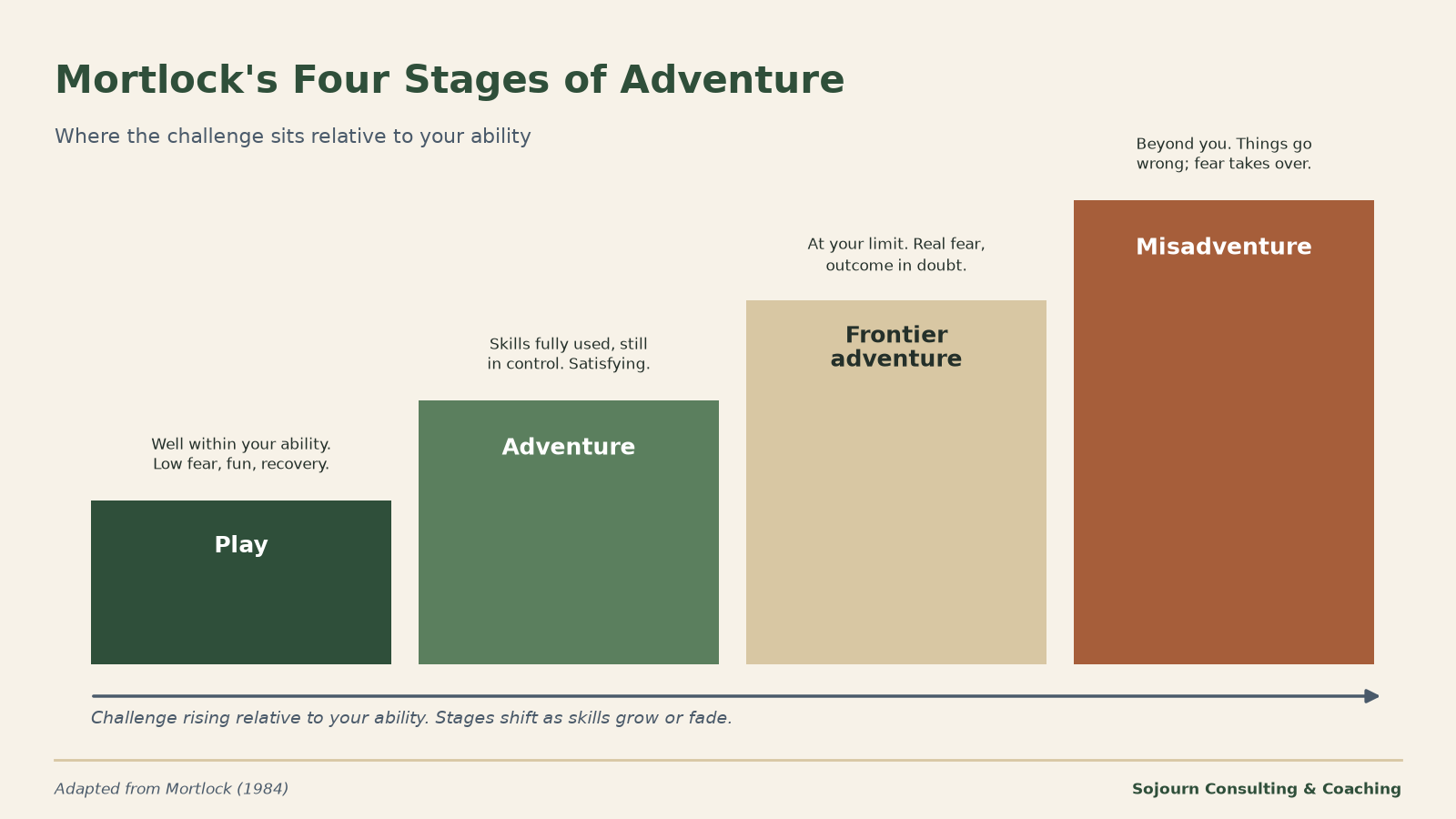
Mortlock’s four stages of adventure, ordered by challenge relative to ability.
What the Stages Mean for You
That's fine as far as it goes. But the useful part is the honesty it asks for. A few things I take from it:
Frontier adventure is seductive. It's where some of our best memories come from, and it's easy to start needing it. Living at the frontier for years is how people get hurt.
Play is undervalued. Plenty of guides stop playing outside once it becomes work. Stage one is where a lot of joy and recovery comes from.
Misadventure isn't always a disaster. Sometimes it's a turnaround, a bruise and a lesson. What matters is whether you learn from it.
Stages shift. Yesterday's frontier is next year's adventure as skill grows, and the reverse when skills fade (see Antidotes to Skill Perishability).
[KAI: a short personal reflection on a frontier adventure you remember, and what it taught you about your own edges.]
A Reflection Exercise: Your Adventure Inventory
Grab a notebook for this one. It's a good off-season practice.
Step 1: List your last ten outdoor days, personal or work.
Step 2: Label each one Play, Adventure, Frontier or Misadventure.
Step 3: Look at the pattern. Are you all frontier? All play? Is work crowding out your own adventures?
Step 4: Ask what you want the mix to look like next season, and why.
Step 5: Pick one change: a day of pure play, or a deliberate step toward a new adventure with the right training and partners.
The Same Stages Off the Trail
I find Mortlock's stages work for life and career choices too. A new job can be adventure or frontier. Starting your own business is often frontier for a while. Questions worth asking:
Where am I in my work right now: play, adventure, frontier or misadventure?
Is that where I want to be?
If I'm at the frontier, what support and skills would move it back to adventure?
If I'm in play and bored, what's the next adventure?
If the answer points toward a change of program, 10 Filters for Examining Organizations Prior to Application is a good next read.
Talking About Edges Without Bravado
Our industry has a habit of telling misadventure stories as funny war stories. Some of them are funny. But the culture can quietly reward frontier adventure and treat stepping back as weakness. Mortlock's (1984) stages give you neutral language for an honest conversation with friends, partners, and co-workers about where you are.
"That felt like frontier for me, not adventure." That's information for your partner, not a confession.
"I want a play day this weekend." That's a valid goal for a professional, not a cop-out.
"I think that was misadventure, even though it worked out." This is the most important sentence on the list.
Saying these out loud makes it easier for others to say them too. Over time, it builds a group where people can turn around without losing face, which is exactly the kind of culture that keeps people in the field for decades instead of a few hard seasons. Longevity in this work depends on it.
Who we serve and how we help
Thinking about your next adventure, on the trail or in your career? Sojourn's coaching is one-on-one work for outdoor lovers, guides and outdoor professionals: collaborative exploration, compassion and blunt honesty about where you are and where you want to go. Sessions are $250, and the first conversation is free.
Book a free intro session or see coaching services.
References
Mortlock, C. (1984). The adventure alternative. Cicerone Press.
Mortlock, C. (2001). Beyond adventure. Cicerone Press.
As always, I'm open to thoughts, feedback, and continual revision on these posts, so please message me anything you'd add or push back on. Thanks for your time and energy!
Kai Roche, Sojourn Consulting & Coaching
sojournconsulting.org
Photo by Ryan Franco on Unsplash