After a guide reads about the conditional outdoor leadership theory, the next question is usually more personal: "Okay, but what kind of leader am I, and why do some groups follow me and others don't?" That's a question about where your influence comes from, and it's a good one to sit with as you grow in this field.
The short answer: Outdoor leadership styles describe how you share decisions with a group, but your influence also depends on whether you were appointed or emerged as a leader, and on what your power rests on: your role, rewards, consequences, expertise or the respect people have for you. Guides who know their sources of influence can lead well even without a title.
Styles: A Quick Recap
The autocratic, democratic and abdicratic styles go back in part to Kurt Lewin's studies of group "social climates" in the late 1930s (Lewin et al., 1939), and outdoor leadership texts adapted them for the field (Priest & Gass, 2018). Most guides have a default style, the one you slip into when you're tired. Knowing yours is the first step to flexing on purpose.
When I'm stressed, do I take over, ask for input or step back?
Which style do co-leads and participants say I use most?
Which style do I avoid, and why?
Designated vs. Emergent Leaders
Priest and Gass (2018) draw a line between designated leaders, who are appointed (the trip leader on the roster), and emergent leaders, who come to lead because the group turns to them. Both happen on every trip.
That's fine as far as it goes. But here's where it gets real for your career. As an assistant or new guide, you may have little designated authority, and still be the person the group comes to when the stove won't light. That's emergent leadership, and it's often how people get noticed and promoted. On the other side, a designated lead who never earns emergent trust will spend the whole trip pushing a rope.
The Five Bases of Power: Where Your Influence Comes From
John French and Bertram Raven (1959) described five bases of social power, and they map well onto field leadership:
Legitimate: influence from your role. "I'm the trip leader."
Reward: influence from what you can give. Praise, the good tent site, a later wake-up.
Coercive: influence from consequences you can impose. Losing privileges, being sent home.
Expert: influence from what you know and can do. The person who can actually read the river.
Referent: influence from respect, trust and relationship. People follow you because they want to.
The first three come with the job title. The last two you build yourself, and they're the ones that last. A guide leaning mostly on legitimate and coercive power tends to get compliance, not commitment.
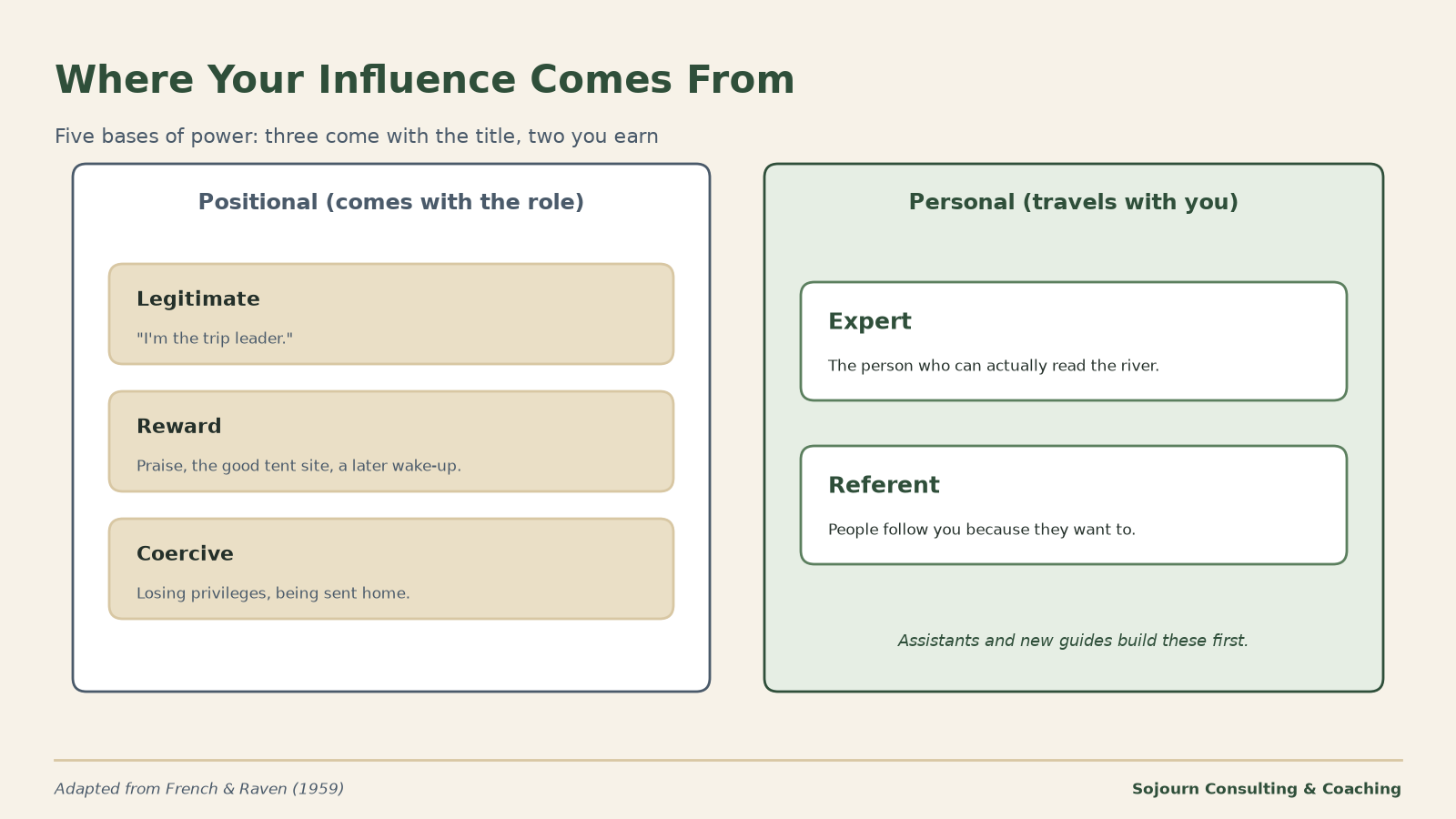
Five bases of power: three come with the title, two you earn.
An Exercise: Map Your Influence
Step 1: Think of your last trip or contract. For each of the five bases, rate how much you relied on it, 1 to 5.
Step 2: Ask a trusted co-lead to rate you too. Compare. (Brace yourself, it's humbling.)
Step 3: Pick your lowest of expert or referent power.
Step 4: Choose one action for next season. For expert power: a skill to deepen. For referent power: one relationship habit, like checking in one-on-one with each participant by day three.
Step 5: Re-rate at the end of the season.
Using This in Your Career
Where your influence comes from shapes the roles you'll thrive in. Questions to ask yourself:
Do I want designated leadership (lead guide, program manager), or do I do my best work as a strong emergent leader?
Which power base would a promotion require me to build?
Am I relying on a title I might not have at the next program?
For the full skill set leaders are measured on, see The 12 Core Competencies of Outdoor Leaders. Group culture shapes who emerges too; Expeditionary Behavior covers that. And if you're choosing your next program, 10 Filters for Examining Organizations Prior to Application will help you find one where you can grow into the kind of leader you want to be.
Power Without a Title: Notes for Assistants and New Guides
If you're early in your career, you probably have little legitimate, reward or coercive power. That's fine. The good news is that expert and referent power are available to you from day one:
Expert: be the person who's really good at one thing, whether that's stove repair, knots, plant ID or the camp kitchen.
Referent: learn names fast, follow through on small promises, take the unglamorous jobs without being asked.
Support the lead in public: raise disagreements privately with your lead, and back them in front of the group.
Know when to step forward: emergent leadership that undercuts the designated lead damages trust; emergent leadership that fills a gap builds it.
Leads notice this. Program managers notice this. In a small industry where references travel fast, the reputation you build with these two power bases follows you to your next program. It's also good practice for when you do have the title, because by then you'll already know how to lead without leaning on it.
Who we serve and how we help
Figuring out what kind of leader you want to become? Sojourn's coaching is one-on-one work for guides and outdoor professionals: collaborative exploration, compassion and blunt honesty about where you are and where you want to go. Sessions are $250, and the first conversation is free.
FAQ
What are the main outdoor leadership styles?
Autocratic, democratic and abdicratic, which differ in how much decision-making power the leader keeps or shares. Skilled leaders shift between them as conditions change (Priest & Gass, 2018).
What is the difference between a designated and an emergent leader?
A designated leader is formally appointed; an emergent leader is someone the group turns to on its own. Both can exist in the same group (Priest & Gass, 2018).
What are the five bases of power?
Legitimate, reward, coercive, expert and referent power, as described by French and Raven (1959).
References
French, J. R. P., Jr., & Raven, B. (1959). The bases of social power. In D. Cartwright (Ed.), Studies in social power (pp. 150–167). University of Michigan, Institute for Social Research.
Lewin, K., Lippitt, R., & White, R. K. (1939). Patterns of aggressive behavior in experimentally created "social climates." The Journal of Social Psychology, 10(2), 269–299. https://doi.org/10.1080/00224545.1939.9713366
Priest, S., & Gass, M. A. (2018). Effective leadership in adventure programming (3rd ed.). Human Kinetics.
As always, I'm open to thoughts, feedback and continual revision on these posts, so please message me anything you'd add or push back on. Thanks for your time and energy!
Kai Roche, Sojourn Consulting & Coaching
sojournconsulting.org
Photo by Frederick Shaw on Unsplash